
Valve Material Selection: A Practical Guide for Abrasive and Corrosive Service

Valve material selection has a direct effect on equipment reliability, maintenance demand, and operating life. A valve can have the correct size and pressure rating yet still suffer premature failure if its materials are unsuitable for the process.
In mining, mineral processing, and industrial applications, valves may face abrasive particles, aggressive chemicals, changing temperatures, and high pressure drops—sometimes within the same duty. Effective selection considers these conditions together and evaluates the complete valve assembly.
Start with the operating conditions. Before comparing materials, establish what the valve must handle throughout its service life. Useful information includes:
Fluid composition, chemical concentration, and contaminants.
Solids concentration, particle size, and particle hardness.
Normal, minimum, and maximum operating temperatures.
Inlet pressure, outlet pressure, and pressure differential.
Minimum, normal, and maximum flow rates.
Isolation or throttling duty, operating frequency, and shutoff requirements.
Include startup, shutdown, and cleaning conditions where they differ from normal operation. Manufacturer selection guidance emphasises understanding the full operating range and checking material compatibility against product data. Swagelok valve selection guidance
Identify the mechanism causing damage. Corrosion, abrasive wear, and cavitation require different responses.
Corrosion involves chemical or electrochemical attack. Its severity depends on the particular material, fluid chemistry, concentration, temperature, and surrounding conditions. Stainless steel can be suitable for many services, but chloride-containing environments can create risks of localised corrosion and stress corrosion cracking. Swagelok materials guidance
Abrasive wear occurs when particles damage exposed surfaces. In a valve, this can affect the flow passage, sealing surfaces, and moving components. Particle characteristics, velocity, and pressure differential help determine whether a lining, hardfacing, or different trim material should be considered.
Cavitation occurs when vapour bubbles form and subsequently collapse as liquid pressure changes through the valve. It can cause pitting, vibration, noise, and material damage. Addressing cavitation requires review of the hydraulic conditions and valve design alongside material selection. Emerson cavitation guidance
Review the body, trim, lining, and seals together. Specifying the valve body material is only part of the selection process.
The body and bonnet must provide the required pressure-containing strength. Internal components—often called the trim—must withstand the conditions occurring around the valve opening and sealing surfaces. Seats, packing, gaskets, and diaphragms also need suitable chemical and temperature compatibility.
Local velocities inside a valve can exceed those in the connecting pipe. Consequently, the appropriate trim material may differ from the body or piping material. Emerson material selection guidance
Compare material options against the duty. The following families provide a starting point for discussion:
Material optionWhere it may be consideredWhat needs checking316 stainless steelCompatible water and industrial process servicesFluid chemistry, chlorides, temperature, and localised corrosion risksDuplex and super duplex steelsSelected corrosive and chloride-containing servicesExact grade, operating conditions, and fabrication requirementsNickel alloysSpecific aggressive chemical or demanding process dutiesCompatibility of the particular alloy with the actual fluidPFA, FEP, and PTFE liningsCompatible chemical services requiring a protective barrierLining compatibility and the complete valve’s operating limitsCeramic linings or trimAbrasive and erosive servicesCeramic grade, chemical compatibility, mechanical loading, and thermal changesCarbide hardfacingWear-exposed valve surfacesBase material, hardfacing specification, coverage, and process compatibility
Alloy families contain grades with different properties; a material name alone does not establish suitability. Corrosion-resistant alloy comparison
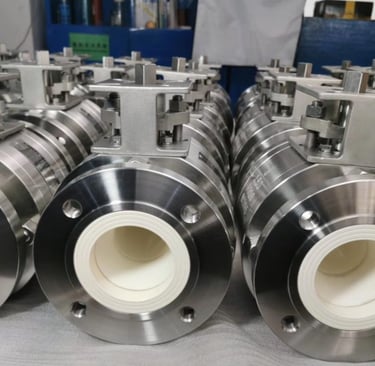
Ceramic flow paths and trim can provide effective protection in highly erosive applications, but their performance also depends on the ceramic formulation and valve construction. Ceramic valve design example
Use failure evidence to guide an upgrade. When replacing a valve, record where damage occurred and how the component failed. Photographs, operating hours, inspection findings, and maintenance history make the selection discussion more useful.
For example, worn sealing surfaces in slurry service may justify investigating abrasion-resistant trim. Chemical deterioration of a seat requires a compatibility review. Cavitation damage calls for examination of the pressure conditions and flow path. Each observation helps focus the proposed change on the cause of failure.
Compare the cost over the operating life. Purchase price is one part of the decision. Replacement frequency, maintenance labour, spare parts, access requirements, and production interruptions also influence value.
An upgraded material may justify its additional cost when it addresses a documented failure mechanism and extends useful service. Tracking performance after installation helps establish whether the change delivered the expected improvement.
Discuss your valve duty with Abracore. Abracore supports valve selection, sizing, material recommendations, and replacement compatibility for abrasion-resistant and corrosion-resistant applications.
Send your process conditions, valve datasheet, drawings, and available failure history to help identify a suitable material and valve configuration.
Contact Abracore to discuss your application or request a quotation.
Quick Links
Flow Control Valves
Solenoid Operating Globe Valves
Electromagnetic Flowmeter